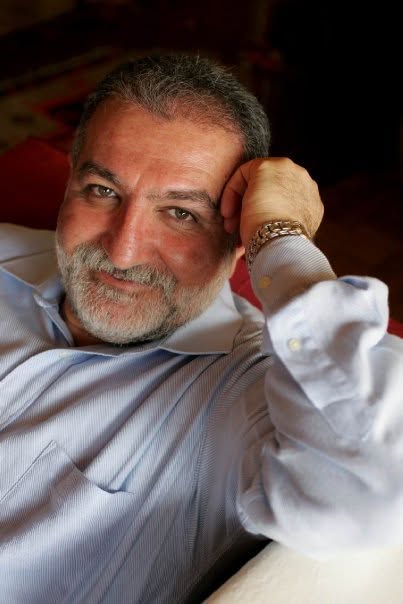
Cemîl Tûran Bazîdî was born in 1952 in Doğubayazıt (Kurdish: Bazîd), in Turkish Kurdistan. Growing up in a family of Kurdish independence activists and fighters, Turan joined the movement for an independent homeland at a very young age. Initially a student at Ankara University and later at Istanbul University, he was at the forefront of the Kurdish movement, confronting the two military coups of 1971 and 1980.
He was persecuted for his activism and political involvement, imprisoned, and subjected to all forms of torture. In 1984, he managed to escape and flee to Greece, where he sought political asylum and later acquired Greek citizenship.
He worked as a journalist at the Ministry of Digital Policy, Telecommunications and Media, while his articles and political analyses were published in both the Greek and Kurdish press.
He is an Honorary Academic at the International Academy of Sciences, Technology, Education and Humanities (Valencia, Spain). UNESCO, as part of the Intercultural Mediterranean Programme developed by the Valencia-Mediterranean Centre, awarded him an Honorary Distinction.
His first novel, a work of testimony entitled The Blood-Stained Snowdrop (Kastaniotis Publications), was published in 2001. It was also the first literary work by a Kurdish author to be written in Greek. His subsequent publications, all in Greek, include The Eyes of the Wolf (2003), The Night That Saw the Day (2006), The Children of Ararat (2008), There, God Was Asleep (2013), My Name Is Azad (2015), The Kurdish Question in the Greek Press (2021), and the illustrated album Colours Initiated into Our Lives (2017), whose illustrations were inspired by descriptions found in the author’s books.
In 2016, he created a Diary dedicated to Kurdish poetry, which served as the precursor to two anthologies: Contemporary Kurdish Poetry (2020) and Women Poets of Kurdistan (2026).
His books have been translated into several languages, in addition to Kurdish and Turkish.